
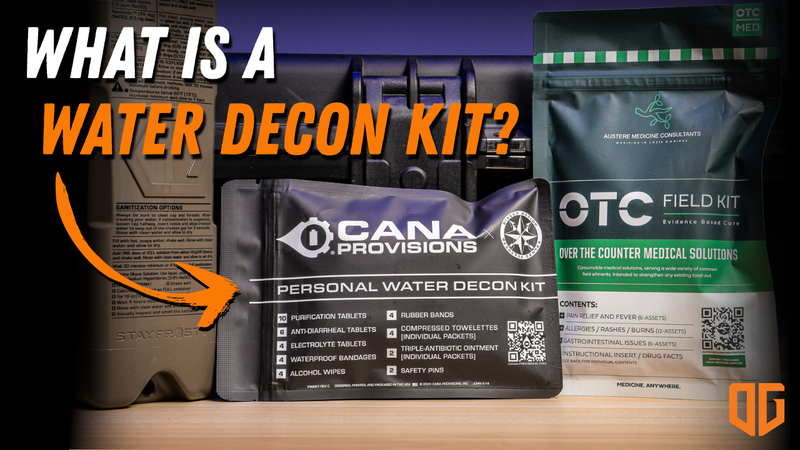
What Is a Water Decon Kit and Why Every Prepared Citizen Needs One
Zach, the founder of Cana Provisions, went through DARC's Tactical Urban Sustainment Course as a student. Midway through a multi-day field exercise, his group ran critically short of clean water. Of the seven filters that were being used among their group, six of them have failed. Resupply wasn't coming. Trained, experienced people were in a bad spot because nobody had built a personal water capability that worked independently of the group.
That's where the Cana Provisions Personal Water Decon Kit came from: a real issue that real people ran into during real training.
Water security is one of the most consistently overlooked gaps in any preparedness kit, so Zach looked to create a solution for moving and treating water in austere environments.
What Does a Water Decon Kit Actually Do?
A water decon kit gives you the ability to make found water safe to drink using chemical treatment — no pump, no electricity, no equipment beyond a drinking container and what's in your pocket.
The Cana Provisions Personal Water Decon Kit contains purification tablets, electrolytes, anti-diarrheal tablets, compressed towelettes, alcohol wipes, purification instructions, and more, all sealed in a heat-welded mylar bag with a resealable zipper. Combined, these contents give you the ability to filter dirty water and purify it for consumption. The tablets handle bacteria, viruses, and protozoa, while the electrolytes enhance your ability to rehydrate. In a sustained emergency or high-output field environment, water volume alone doesn't keep you functional. Electrolyte balance does. It’s a thoughtful addition to the kit.
The purification instructions cover dosing and wait times depending on initial water quality. This is important. Cana built their entire product line with the understanding that mental math and organization becomes much more difficult when you're dehydrated, stressed, and working in low light. The information should be on the kit, on your bottle, or on a Water Data Card tethered to your kit — so you execute correctly the first time.
When it comes to water security, redundancy is key. There are many ways to decontaminate water. Having multiple tools in your tool kit ensures that you always have the right tool for the job, and if one method fails, you have backup.
Note: One rule that applies to any chemical water treatment: never stack treatments. Don't combine tablets with bleach, aquamira, or any other chemical disinfectant. If you treat a container and hand it to someone else, they need to know it's been dosed. Label it. Communicate it. Double-dosing isn't harmless.
How Is a Water Decon Kit Different from a Filter?
They solve different problems. You want both.
A filter removes particles, sediment, bacteria, and protozoa by physically passing water through a membrane. It's your primary tool when you have time and access to your pack. The limitation: most portable filters don't remove viruses, which become a real threat in flood scenarios, sewage contamination, or anywhere infrastructure has failed. Furthermore, filters can become clogged, or they can break or freeze. Once that happens, they are no longer reliable.
The decon kit uses purification tablets to kill biological threats including viruses. It requires nothing but a container and what’s included in the kit. It's what you have when everything else isn't available — when you're separated from your pack, when the team’s main filter is clogged or frozen, when you need to treat water fast and move.
Filter first if you have one. The tablets work better in clearer water, and filtering removes particulates that reduce their effectiveness. But the decon kit works alone when it has to, which is exactly when you'll need it most.
When Do You Actually Need One?
The scenarios are more common than most people would think or plan for.
System failures. When water treatment plants are overwhelmed, they can and have failed. This can leave tens of thousands of people without safe, running water. Maintaining the ability to purify water keeps you from becoming another liability in a crisis.
After a natural disaster. Municipal water systems go down after hurricanes, floods, and earthquakes. Boil-water advisories can last days or weeks — and that assumes you still have a way to boil water. A kit in your bag means you have a baseline from the moment things go wrong.
When you're responsible for other people. If you are the head of your family, group, or simply a prepared citizen that seeks to be an asset to those in need, maintaining the ability to provide clean water is an immensely valuable skill. Moreover, the idea is that your kit is simple enough and complete enough that you can hand it to the person next to you and they can execute without you. That's a different standard than just taking care of yourself, and it's the right one for anyone who might have people depending on them.
In your vehicle or everyday bag. A grid-down event, a multi-day road trip that goes sideways, a flood that cuts off your route home — these scenarios can make water security an instant issue. The decon kit weighs nothing. There's no good reason it shouldn't be in your car, your EDC bag, or your bug out bag right now.
Where Does It Fit in a Complete Water Plan?
The decon kit is your personal baseline. It shouldn’t be plan A, but it’s there when your main source of clean water runs dry or fails. It's not your entire water strategy. Here's how a complete water preparedness plan layers out:
What's on your body. The decon kit. If you're separated from everything else, you still have something. This is Layer 1 regardless of anything else you carry.
Your personal carry. A small EDC bag with additional tabs, a rehydration kit, Data Cards, and optionally a UV purifier like a SteriPen for personal use. Simple enough to hand off to someone else intact.
Your pack. A gravity filter, hard water containers, and the H2gO Chlorine Generator for treating larger volumes. At this level you can sustain yourself for multiple days and cover a small group.
Team scale. Multiple settling containers, filters, bulk tablets, documented and labeled Jerry cans, etc.. This is the point where you've taken on the water responsibility for a group — everyone knows it, and you're equipped for it.
You build to the mission. A daily commuter needs Layer 1. Someone running a 3-day field course needs Layers 1 through 3. Someone responsible for a family in an extended emergency needs all four. Thanks to Cana Provisions, the gap between having nothing and having Layer 1 is $24 and a minute of thought about where to put it.
Frequently Asked Questions
Can a water decon kit treat any water source? Purification tablets are effective against bacteria, viruses, and protozoa. They don't remove heavy metals, fuel residue, or industrial chemical contamination. For most emergency scenarios — floods, infrastructure failure, field water collection — tablets address the primary threat. If your source may contain chemical contamination, you need additional treatment steps.
How long do water purification tablets last in storage? Most tablets are shelf-stable for 4–5 years sealed in a cool, dry location. Rotate your stock on a schedule the same way you would food storage or medical supplies. The Cana kit's mylar packaging is specifically designed to extend shelf life in varied storage conditions.
Can I use a decon kit as my only water treatment method? Yes, in a genuine emergency it works standalone. But your plan shouldn't depend on a single method. Filter first when you can — it removes particulates, improves taste, and makes the tablets more effective. Pair chemical treatment with filtration whenever possible and treat the decon kit as your guaranteed baseline, not your only option.
Why does the instruction card say not to stack chemical treatments? Combining different chemical disinfectants — tablets, Aquamira, bleach, iodine — at high concentrations can cause problems. More practically, double-dosing a container that someone else already treated is a real risk when multiple people are sharing water in the field. Label treated water. Make sure whoever you hand it to knows whether it's been dosed.
What size pouch or pocket fits the Cana decon kit? At 1.2 oz it fits in a cargo pocket, a blouse pocket, a chest rig admin pouch, or the rear pocket of an IFAK. The size is deliberate — there's no reason to leave it behind.
Who is this for? Anyone who might find themselves needing to make water in a situation where their normal options aren't available. That includes first responders working in flood or disaster conditions, military and veterans who know what field resource shortage actually looks like, parents and family heads who want to be the capable one when something goes wrong, and prepared citizens who have decided they'd rather be an asset to the people around them than a burden. The kit is simple. The decision to carry it is about taking your water plan as seriously as you take the rest of your kit.
What's Your Water Plan?
It's the question you may want to ask yourself, because most people who consider themselves prepared haven't fully answered it yet.
Start with the Cana Provisions Personal Water Decon Kit and build from there. See the full Cana Provisions lineup at Off Grid Warehouse.
About the Author
Pete fulfills many roles at Off Grid Warehouse. He is a Christian, an outdoor enthusiast, hunter, fisherman, trains jiu jitsu, and likes to stay proficient at the gun range.
-
 PREPAREDNESS / FOOD SUPPLY Peter Rome | September 28, 2026 | 9 min read In February 2021, Winter …Sep 28th 2026
 -
 EDC / EVERYDAY CARRY Joe Giumarello | August 21, 2026 | 7 min read Fig. 1: Everything in this …Aug 21st 2026
 -
 Zach, the founder of Cana Provisions, went through DARC's Tactical Urban Sustainment Course as …May 11th 2026