
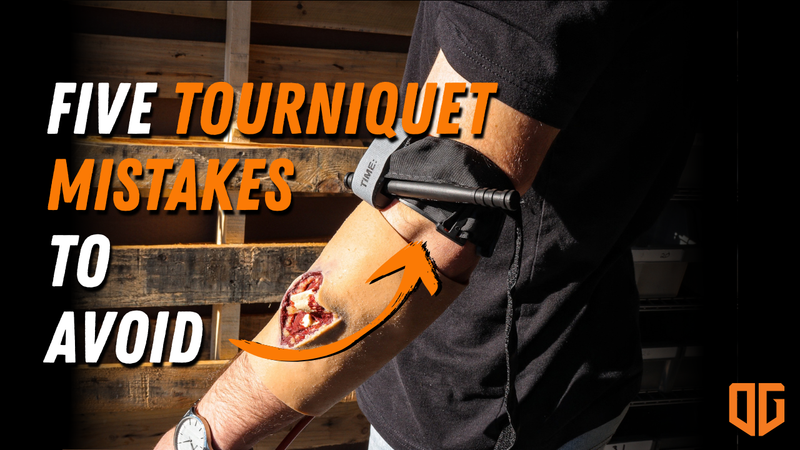
5 Tourniquet Mistakes to Avoid
| MISTAKES | |
| 1. Not Removing All The Slack | |
| 2. Creating a “Dog Ear” | |
| 3. Tourniquet Over Joint | |
| 4. Too Close to the Wound | |
| 5. Poor Orientation |
When it comes to emergency bleeding control, a tourniquet can be the difference between life and death. But a tourniquet only works if it is applied correctly. In the real applications, people are stressed, hands are shaking, lighting is bad, clothing is in the way, and the patient is moving. That is exactly when small mistakes turn into big failures.
Below are five common tourniquet mistakes that show up again and again. Fixing these will make your application faster, cleaner, and more effective.
The Overview
| MISTAKE | REASONING |
| 1. Not Removing All The Slack | |
| 2. Creating a “Dog Ear” | |
| 3. Tourniquet Over Joint | |
| 4. Too Close to the Wound | |
| 5. Poor Orientation |
1. Not Removing All Slack Before Using the Windlass
One of the most common failure points is leaving slack in the band before you ever touch the windlass. Many tourniquets, like the C-A-T, are designed so you route the strap through a buckle and then pull the slack out before you start turning.
If the strap is not pulled hard to remove all the slack, you can end up doing a lot of windlass turns without getting effective compression. This can also increase the chance of a windlass failure.
What to do instead:
- Route the strap the way your tourniquet is designed to be routed.
- Pull the slack out aggressively so the tourniquet sits tight before you turn the windlass.
- Then use the windlass to finish tightening until bleeding is controlled.
Quick check: If you can easily slide two fingers under the strap before you start turning the windlass, it is probably too loose.
2. Creating a “Dog Ear” (Band Not Fully Secured)
A “dog ear” is when your tourniquet is applied but the band is not fully secured. It might seem harmless, but it can catch on gear, doorways, seat belts, and litter straps. During movement, a snag can release the pressure that the tourniquet is applying. It is important to secure the remaining portion of the strap to prevent the tourniquet releasing.
What to do instead:
- Keep the wrap flat and smooth. No twists. No bunching.
- Secure all Velcro and any retention straps.
- Before you move the patient, do a quick “snag sweep” with your hand to make sure nothing is sticking out.
3. Placing Tourniquets Over Joints and Gear
It is common to have items in pockets, whether on a shirt sleeve or pant pockets. Those pockets often hold small items, like wallets, phones, or car keys.
A tourniquet needs direct, even pressure on the limb to compress the artery. If anything is between the extremity and the tourniquet, it acts like a buffer. That buffer reduces compression, makes it harder to occlude blood flow, and can cause the tourniquet to slip or shift.
You also cannot place a tourniquet over a joint (knee, elbow, ankle, wrist) because joints create uneven surfaces, gaps, and hard edges. That makes it difficult to tighten the strap evenly around the limb. You often end up cranking harder but still getting poor occlusion. A joint placement can also shift as the limb bends, which can loosen pressure over time.
What to do instead:
- Remove anything under where the tourniquet needs to sit, including pockets, holsters, and protective gear when possible.
- Clear bulky items out of pockets (or move the tourniquet above them).
- Move the tourniquet above the joint to a straight section of limb where you can get a flat wrap.
- Apply the tourniquet on a clean section of limb so the strap can lie flat and tighten evenly.
Quick check: If you can feel hard objects, thick seams, or you are sitting on top of a joint, reposition and tighten on a clear, straight spot.
4. Applying the Tourniquet Too Close to the Wound
If the tourniquet is placed too close to the injury, it may not effectively stop bleeding. This is especially true when the wound is large, irregular, or high-energy, because the bleeding source can be deeper than it looks on the surface. Arteries can retract when severed, which is one reason a tourniquet that is “right next to” the wound may still fail.
What to do instead:
- A good rule of thumb is to place the tourniquet at least 2 inches above the wound (commonly 2–3 inches) when possible.
If you are not sure where the wound is:
- If clothing, blood, darkness, or chaos make the wound hard to see, do not waste time trying to measure.
- Go as high as needed on the limb, get it tight, and reassess once bleeding is controlled and you have more bandwidth.
5. Poor Windlass Orientation and Positioning
The position of the windlass can make a dramatic difference in how effectively you can apply the tourniquet. If the windlass is buried on the inner thigh, jammed against the torso, or pressed into a hard surface, it becomes harder to turn and easier to bump loose.
What to do instead:
- Place the windlass where you have the best access and leverage, typically on the outer or top portion of the limb.
- Make sure you can lock it into the retaining clip and secure any straps designed to keep it fro0m unwinding.
- After moving the patient, re-check that the windlass is still locked.
Conclusion
Tourniquet application is a skill. The best time to discover a problem is during practice, not during an emergency. If you carry a tourniquet, practice applying it one-handed and two-handed, on both arms and both legs, with your exact model. It is also great to practice with different types of tourniquets. If an injured individual is carrying a tourniquet, you will use their tourniquet, not yours. In this case, it is best to understand the most common tourniquets, such as the C-A-T, SOF, SAM-XT, and TMT.
-
 PREPAREDNESS / FOOD SUPPLY Peter Rome | September 28, 2026 | 9 min read In February 2021, Winter …Sep 28th 2026
 -
 EDC / EVERYDAY CARRY Joe Giumarello | August 21, 2026 | 7 min read Fig. 1: Everything in this …Aug 21st 2026
 -
 Zach, the founder of Cana Provisions, went through DARC's Tactical Urban Sustainment Course as …May 11th 2026